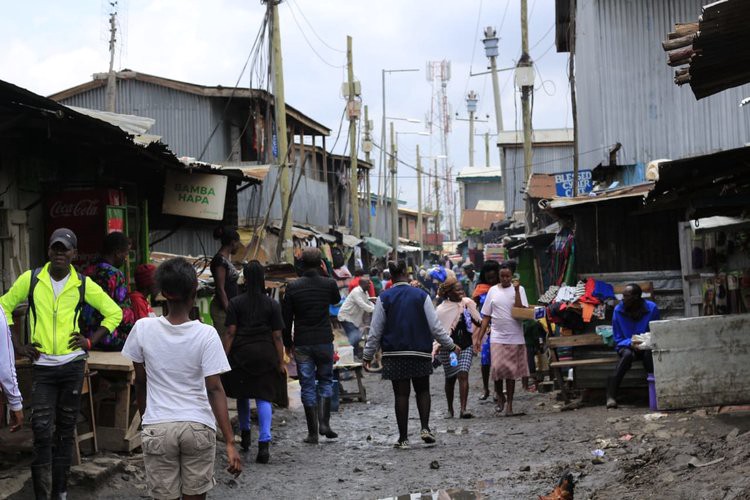

Workshop
The informal sector as a lever for urban food system transformation
Insights from Urban Food Futures scoping research in informal and low-income communities in Nairobi and Cape Town
Recognizing the pivotal role that state actors play in urban food systems, the Urban Food Futures programme is hosting a policy event for the Nairobi County, as an important foundational step for the implementation of our action research.
The policy event will bring together representatives from relevant sectors in Nairobi County, including education, trade, agriculture, urban planning, and social services, as well as experts from civil society, academia and local communities from Nairobi and Cape Town. These urban food system experts will provide insights gained from our transdisciplinary research on urban food systems, the right to food, and the informal sector in the two cities.
Building on our collaboration with two civil society partners, Muungano wa Wanavijiji/Akiba Mashinani Trust, and Miramar Foundation, the event will explore the role of the informal sector as a lever for food system transformation in Nairobi by:
- discussing how to implement five pathways of change identified during the scoping phase;
- exploring opportunities to build learning coalitions between state actors and the research programme to better understand the informal sector’s role in Nairobi’s urban food system;
- agreeing on modalities for building on the Mukuru Special Planning Area: a participatory process that brings together duty bearers and rights holders in the informal settlement;
- exploring how to build a knowledge sharing platform to facilitate continuous peer exchange and monitoring of programme implementation in the two cities.
Approaching change from a rights-based approach enables the development of innovations that go beyond simply meeting immediate needs or coping with crises; these innovations address questions of, for example, accountability of governments or representation of people in vulnerable positions in policy processes. The Urban Food Futures Programme adopts an approach that is conscious of the past injustices that created the structural issues that cause food insecurity. The Programme takes projected futures and megatrends that will impact our cities’ food systems into account. The solutions developed today must meet the changing demands of future urban generations.
Together with our partners in Nairobi, Muungano wa Wanavijiji/Akiba Mashinani Trust and Miramar Foundation, we have developed five pathways for change that will guide our research going forward:
Pathway One: Coping with crises
We explored urban low-income communities’ coping strategies during the COVID-19 pandemic and other crises that increased food insecurity. In the context of the settlement demolitions of November 2021, we observed the pivotal role played by a women-led community kitchen in Mukuru informal settlement that provided a convergence centre for food distribution, awareness raising, networking, and advocating for re-building homes. Going forward, the research programme will pilot options for the Mukuru community kitchen to provide employment and economic opportunities for women through linkages with school feeding programmes. Our experience speaks to the county-supported central kitchens envisioned by the Nairobi Governor as part of their economic inclusivity planning directive.
*Pathway Two: Mutual accountability *
To design programmes and policies for food security, decision-making processes need to take into account people’s lived experiences via participatory processes. In Nairobi City, we analysed the Special Planning Area (SPA) process in Mukuru where more than 40 stakeholders collaborated to create an action plan for upgrades within the informal settlement. However, our mapping exercises also revealed that no single government department is responsible for the city’s food security despite the city’s leadership aspirations that city dwellers are respected and engaged by the county government with dignity and honour. The lack of communication and collaboration platform between citizens and government complicates attempts at well-orchestrated implementation of the SPA plan and other joint government–citizen food security programmes. We will resume the SPA process and build a participatory dialogue that centres urban nutrition hubs in designing approaches to support dialogue between communities and government.
*Pathway Three: Controlled Environment Agriculture for school feeding programme *
In response to the effects of climate change and land degradation on food production in urban, peri-urban, and rural areas, we explored controlled-environment agriculture (CEA) as an option for food production in urban areas. We found that CEA can make a climate-smart contribution to cities’ supply of leafy vegetables. We are interested in using CEA to meet the demand for leafy vegetables within school feeding programmes. This pathway aligns with the resilient food systems envisaged in Nairobi’s climate action plan. We seek to situate CEA production units within urban nutrition hubs and link them to the government-sponsored school feeding programmes.
*Pathway Four: Trading to eat *
In Nairobi’s Mukuru informal settlement, we explored the important contributions informal food vendors make to the last-mile food delivery in urban settlements. The research highlighted the need to invest in improving hygiene standards and basic facilities for food vendors. To do so, government interventions that promote infrastructure for food supply into informal settlements. A precursor to this is better government understanding and recognition of the role of the informal market in urban food security. This understanding builds the platform for government to operationalise the County leadership’s vision of Nairobi as a “city of opportunities” that provides business spaces for informal traders. The County Biashara Fund and national government’s Hustler Fund provide stepping-stones for supporting food vendors. Under the research programme, food vendors associations will coordinate and represent food vendors’ activities.
Pathway 5: Crowdsourcing data
The lack of detailed data on the state of food security in informal settlements limits our understanding of the day-to-day challenges urban dwellers face in their food environments and our restricts our ability to design crises responses. We will pilot a digital system to collect data from the informal sector in Mukuru to provide information on the informal sector’s role in times of crises and its role in addressing food insecurity.
Date
Organisers
Muungano wa Wanavijiji
Miramar International Foundation
Food Agency Cape Town (FACT)
African Centre for Cities
Location
Sarova Panafric Hotel, Nairobi, Kenya
Languages
en
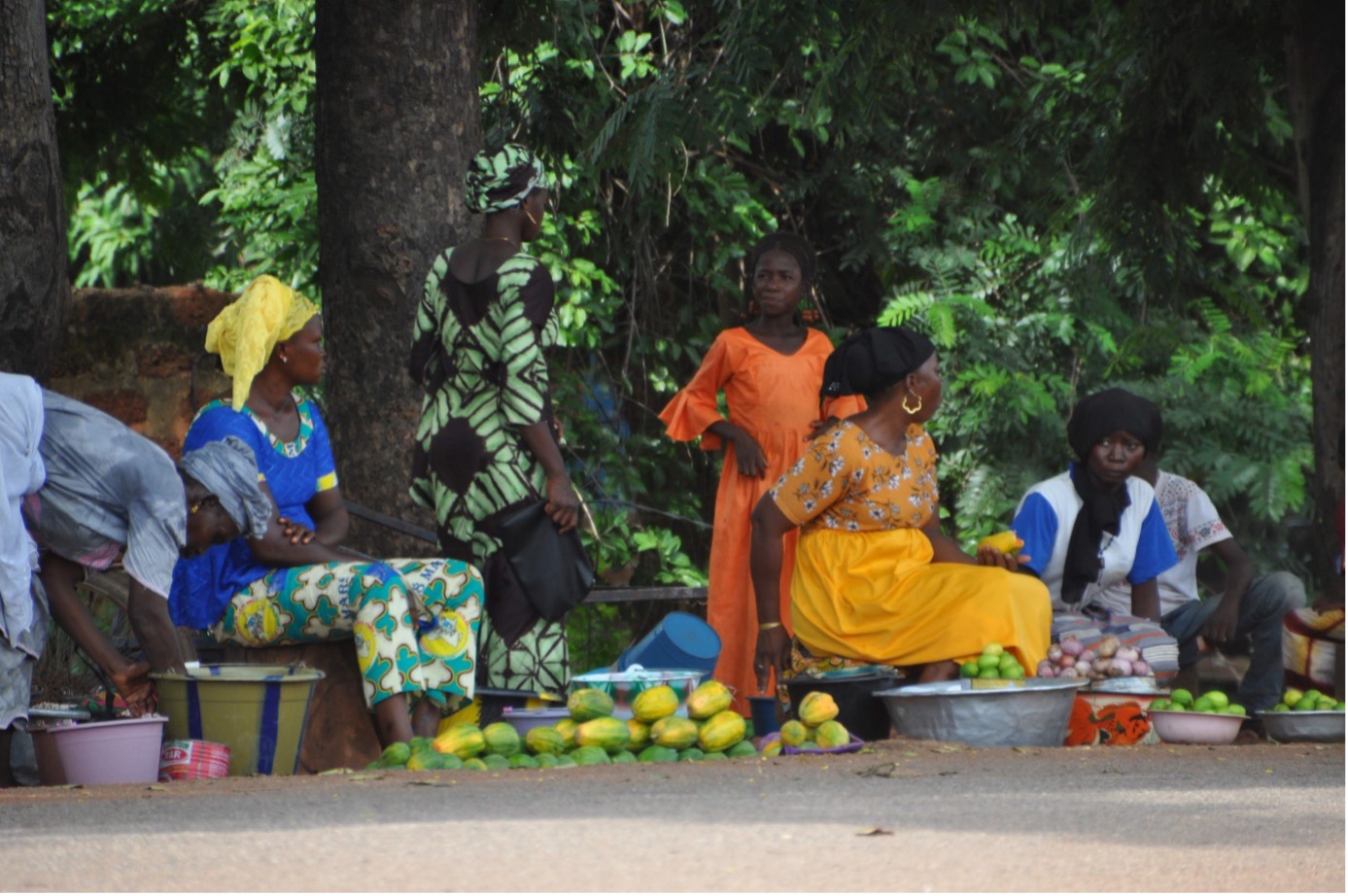
Bridging the disconnect between policy intentions and the realities of urban food insecurity
Nairobi policy workshop to bring together key County decision makers with research and civil society actors to agree on how to implement concrete pathways to tackle persistent hunger and related crises of urban poor
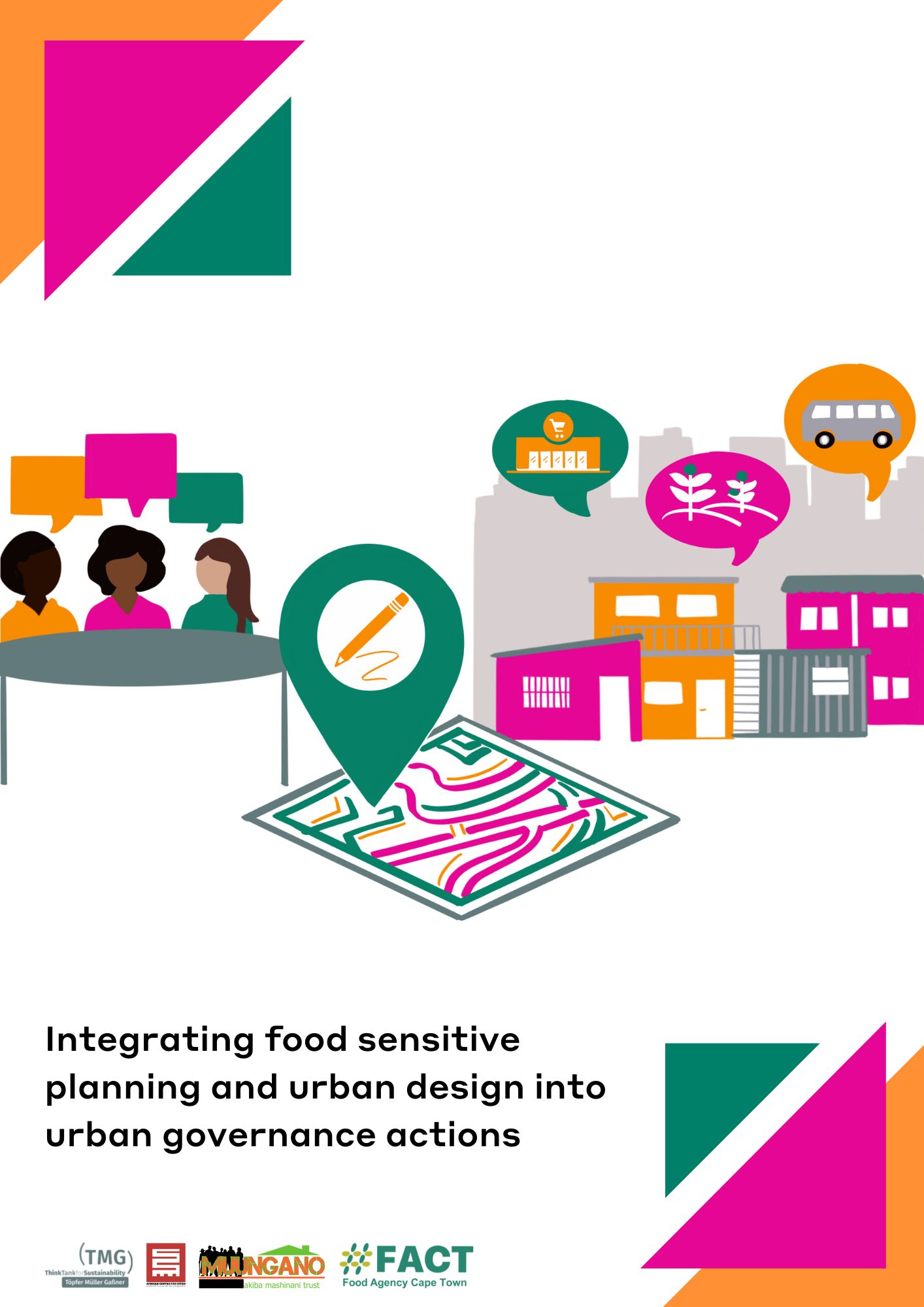
Integrating food sensitive planning and urban design into urban governance actions
An analysis of the scales and concepts of governance and urban food systems, with an eye to the role of societal and community-level agency in disrupting current models of urban food governance
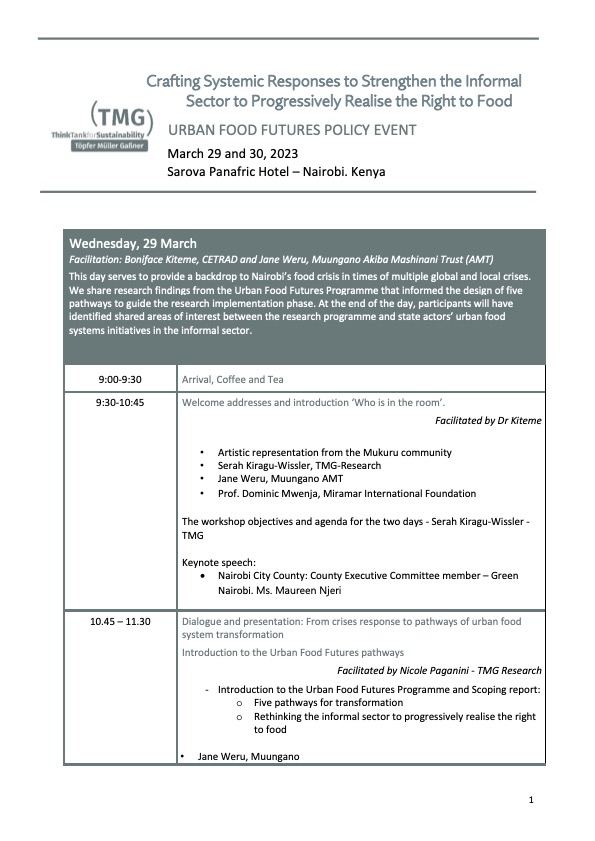
Event Programme
Programme: Nairobi Policy Event
Recognizing the pivotal role state actors play in urban food systems, the Urban Food Futures programme is hosting a policy event for Nairobi County policy makers, as an important foundational step for the implementation of our action research.
Written by Urban Food Futures team
Published on Mar 23, 2023
Report
A Human Rights-Based Approach to Food Security in Kenya and South Africa
Exploring rights-based approaches to food security in low-income urban settings
Written by Elizabeth Kimani-Murage, Maureen Gitagia, David Osogo, Antonina Mutoro, Nicole Paganini
Published on Mar 01, 2023