
Carbon Markets and Community Land Rights
Project developers and buyers of carbon credits from Voluntary Carbon Markets cannot directly resolve land governance challenges in host countries, but they play a critical role in shaping how projects are implemented, and in strengthening governance frameworks for carbon projects. By demanding transparency and credible safeguards, project developers and credit buyers can provide crucial guidance on specific project practices that should be enhanced to improve overall governance and implementation of carbon projects.

Why this project
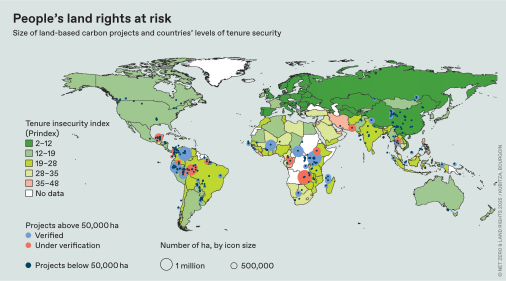
Carbon markets are expanding rapidly, but governance around land rights and community protection is not keeping pace. TMG’s Net Zero & Land Rights (2025) documents how land-based carbon projects are disproportionately located in countries with weak or insecure land tenure systems and how this structural mismatch risks leading to land rights and human rights violations and consequently puts these projects at risk of cancellation.
- Investors in land-based carbon projects (in the voluntary market) wield significantly more power than local communities. Correcting this imbalance requires policymakers, project developers and buyers to actively prioritise communities’ land rights.
- Existing standards (e.g. Verra, ICVCM) provide guidance, but implementation remains inconsistent, especially because land issues vary from one country to another.
- Recent controversies in Kenya, including projects linked to the Northern Rangelands Trust, highlight risks of inadequate Free, Prior and Informed Consent (FPIC), unresolved land tenure issues (unresolved land documentation status), and weak grievance mechanisms.
- Evidence shows there is no contradiction between protecting land rights and achieving climate outcomes: community-based conservation projects show predominantly positive environmental results across restoration, biodiversity, and ecological condition indicators.
Most community engagement toolkits and guidelines for carbon offsetting projects are designed to support communities in negotiating with project developers. This project targets instead developers and credit buyers, where decisions about land governance and community consent are made or overlooked. The project will also present the research findings to relevant government actors who could act on the recommendations to improve land governance in the context of carbon offsetting projects.
Project approach
The following elements shape how we work:
- The project examines two land-based carbon projects in Kenya, the Northern Kenya Grasslands Carbon Project (NKGCP) and the Kajiado Rangelands Carbon Project (KRCP), that faced media scrutiny after communities alleged insufficient consultation and absence of FPIC. Drawing on these documented cases, the project traces how specific land governance failures escalated into community opposition, legitimacy breakdown, or ultimately project cancellation.
- Findings are translated into accessible formats for the diverse actors operating in carbon markets, including those with limited familiarity with land governance principles. The goal is to bridge the gap between land governance expertise and carbon market practice.
- The project engages diverse actors within Kenya’s carbon markets ecosystem, including: Carbon Markets Association of Kenya, GIZ, German Embassy, Verst Carbon, Octavia Carbon, Eastern Africa Alliance on Carbon Markets and Climate Finance, ICVCM, and others.
Expected outputs and outcomes
Case-based analysis of carbon market failures (Kenya)
Decision-tree for developers / Buyer-side due diligence checklist
Stakeholder dialogue and training
Pilot engagement with selected developers and buyers
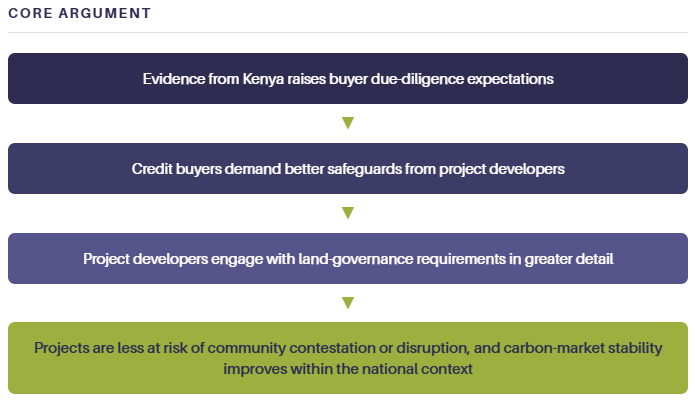
Core argument
Audiences and entry points
Project developers
Early attention to land issues reduces the risk of community disputes, legitimacy challenges, and credit cancellation.
- Go beyond minimum compliance: engage land-governance specialists from the earliest stages of design, with deep understanding of international frameworks, national land law, and local social and cultural dynamics.
Kenyan government
Projects that face controversy or cancellation over unresolved land issues can erode confidence in Kenya's carbon market and depress credit prices across the sector.
- Encourage developers to include land-governance specialists from the outset.
- Establish a dedicated focal point within the Ministry responsible for lands to support developers in identifying and addressing land-related issues prior to project commencement.
Carbon-credit buyers
Stronger buyer due diligence incentivises more responsible project development and reduces the risk of disputes, reputational harm, or credit invalidation.
- Prioritise credits from projects that demonstrate adequate treatment of land issues from the outset: clear identification of rights holders, meaningful community participation, and compliance with national land law.