
ICARRD+20 and the Future of Land Governance
ICARRD+20, taking place from 24–28 February 2026 in Cartagena, Colombia, presents a pivotal moment to anchor the future of land governance in human rights principles.
Introduction
ICARRD+20 marks a critical moment for advancing responsible land governance and strengthening land tenure security worldwide. As global demand for land intensifies due to climate change mitigation, biodiversity conservation, infrastructure expansion, and agricultural production, secure land rights and transparent land governance systems have become essential for sustainable development.
Land governance determines how land is accessed, used, and managed. Effective governance protects human rights, promotes economic stability, and enables communities to invest in sustainable land management. ICARRD+20 provides a global platform for governments, civil society, and international organizations to align policies and strengthen commitments to equitable land governance.
What is ICARRD+20?
ICARRD+20 (International Conference on Agrarian Reform and Rural Development +20) builds on previous global efforts to promote agrarian reform and improve land tenure security. The conference focuses on ensuring fair access to land, protecting vulnerable populations, and strengthening responsible land governance frameworks.
ICARRD+20 and the Future of Land Governance
ICARRD+20 comes at a time when land governance and land tenure rights have become central to climate mitigation, biodiversity conservation, and sustainable development.
Cumulative land demands under these agendas are increasing global pressure on land. This makes land governance at ICARRD+20 a core political issue.
Without secure land tenure rights and recognition of legitimate and customary land rights, climate and biodiversity strategies risk undermining food security, increasing land conflicts, and failing to achieve their objectives.
Read our one-pager on why ICARRD+20 matters so much at this moment.
At ICARRD+20, land governance is a core political issue.

Women’s land rights at ICARRD+20
Women’s land rights are critical for sustainable land management, climate resilience, and food security. Strengthening women’s tenure security functions both as a safeguard and as an enabler of effective land-based policies.
Through the Women’s Land Rights Initiative, land tenure under the UNCCD, UNFCCC, and CBD is being addressed in a coordinated way to ensure women’s land rights are integrated into Rio Convention implementation.
Women's land rights protect women from exclusion and dispossession—and enable effective and inclusive implementation of land-based policies.

Environmental commitments, invisible rights: addressing cumulative land demand
Evidence from assessing national action plans under UNCCD, UNFCCC, and CBD shows that customary land rights remain largely invisible in environmental action at national level.
ICARRD+20 must address how cumulative land demand, driven by climate, biodiversity and investment policies, can be governed in ways that protect tenure security and access to land.
Read our one-pager on why cumulative land demand must be visible in policy and planning processes.
Global climate and biodiversity policy ambitions are increasingly heightening pressure on land.

Given current global realities, re-focusing on a shared normative framework—the VGGT—is critical.
The Voluntary Guidelines on the Responsible Governance of Tenure (VGGT) recognize land tenure as essential for sustainable development. Yet implementation remains uneven and largely self-reported.
Strengthening accountability at ICARRD+20 requires linking land governance to measurable tenure security outcomes, human rights safeguards, and independent monitoring mechanisms.
Read our one-pager on strengthening accountability to protect core human rights.
Secure access to land is a precondition for the realization of the right to food, housing, water, and self-determination.

Conclusion: The future of land governance after ICARRD+20
ICARRD+20 represents a critical opportunity to strengthen responsible land governance and advance secure land tenure globally. Its outcomes must now translate into concrete policy action, particularly in the 2026 triple COP year, when climate, biodiversity, and land degradation negotiations will create key implementation opportunities.
TMG will continue working to ensure that ICARRD+20 commitments inform global policy processes and support stronger, more accountable land governance systems. Secure land tenure is essential for climate resilience, sustainable development, and protecting the rights of communities. The success of ICARRD+20 will ultimately depend on sustained political commitment and effective implementation in the years ahead.

Rights4Land Monitoring Tool: Explore our R4L tool, designed to help monitor the land governance situation in given place, ensuring accountability from a human rights perspective.
Net Zero Land Rights: Explore our dedicated website for our publication, "Net Zero Land Rights: How our climate goals drive land demand and shape people's lives," on how net-zero goals are driving unprecedented global land demand, often at the expense of Indigenous Peoples and local communities.

Info Brief
Why ICARRD+20 Matters Now: Land Governance as a Foundation for Sustainable and Inclusive Transformation
Land is finite, but policies on climate, food, and biodiversity are not accounting for it. At ICARRD+20, we highlight why weak tenure, especially for women and Indigenous Peoples, is creating a growing governance gap.
Written by Frederike Klümper, Ilse Pelkmans
Published on Feb 20, 2026
Info Brief
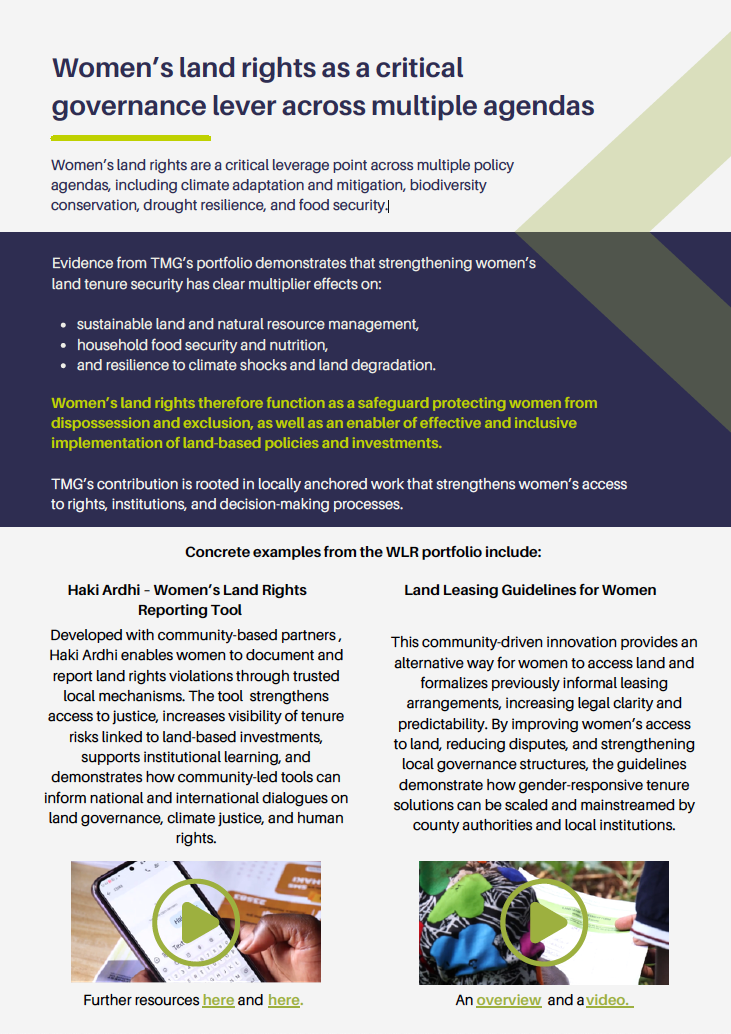
Women's Land Rights as a Critical Governance Lever Across Multiple Agendas
Women’s land rights are a critical leverage point across multiple policy agendas, including climate adaptation and mitigation, biodiversity conservation, drought resilience, and food security.
Written by Frederike Klümper, Ilse Pelkmans
Published on Feb 20, 2026
Info Brief
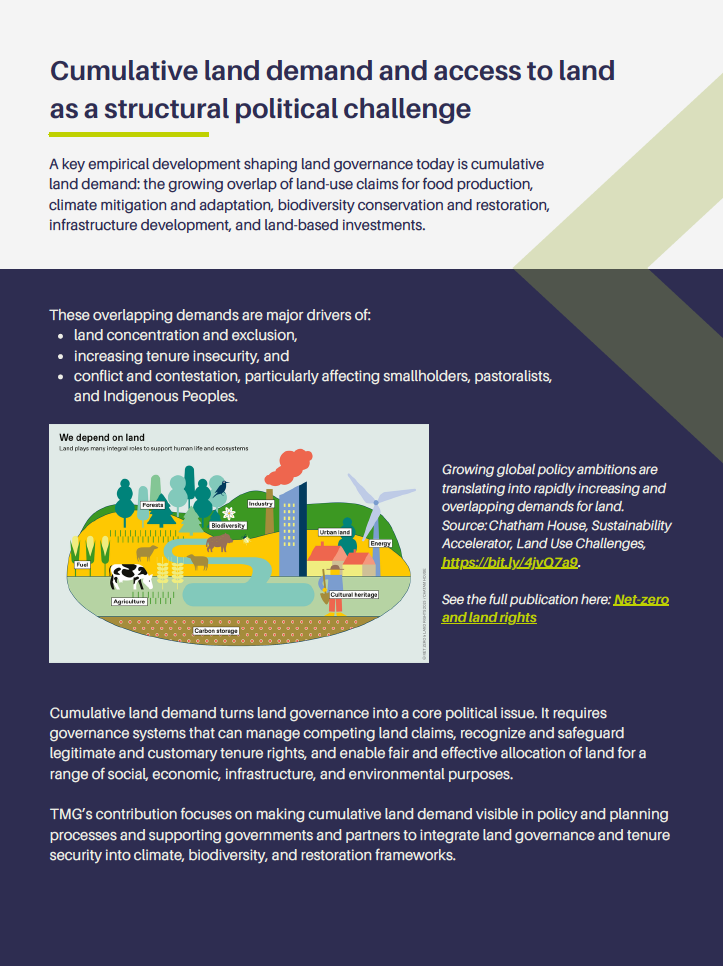
Cumulative Land Demand and Access to Land as a Structural Political Challenge
A key empirical development shaping land governance today is cumulative land demand: the growing overlap of land-use claims for food production, climate mitigation, biodiversity conservation, infrastructure, and land-based investments, and more.
Written by Frederike Klümper, Ilse Pelkmans
Published on Feb 20, 2026

Info Brief
Strengthening Accountability for Land Governance
A decade after the VGGT, land rights are widely recognized—but strengthening accountability is crucial to ensuring that progress is measured in real tenure security and protection from dispossession, not only plans or strategies.
Written by Frederike Klümper, Ilse Pelkmans
Published on Feb 20, 2026
Technical Guide
Rights4Land Monitoring Tool Manual
This manual provides guidance on how to use the Rights4Land (R4L) monitoring tool, which assesses the extent to which a given location complies with the VGGT—international standards for responsible land governance—and underlying human rights obligations.
Written by Ilse Pelkmans
Published on Feb 18, 2026
Report
Summary Report: Human Rights & Land Governance in Sierra Leone - Rights4Land Assessment
The Rights4Land (R4L) land governance assessment in Sierra Leone reveals gaps in the implementation of the Voluntary Guidelines on the Responsible Governance of Tenure of Land, Fisheries, and Forests (VGGT) and compliance with human rights obligations.
Written by Daniel Montas, Ilse Pelkmans
Published on Feb 18, 2026

Policy Brief
Unlocking Land Tenure: Pathways for policy action after the triple COPs of 2024
This brief presents a powerful analysis of 2024's landmark triple-COP year, highlighting land tenure outcomes across the Rio Conventions. It maps key decisions, advocacy entry points, and opportunities to advance land rights in global land governance.
Written by TMG Research
Published on Jun 03, 2025

Report
Land rights formalisation and farmers’ decisions to invest in sustainable land management
The ProPFR project helped rural Benin communities—especially women—secure land rights through customary certificates. TMG and APIC built on this to explore how land formalisation drives sustainable farming and boosts farmers’ confidence in land ownership.
Written by Kader Baba, Frederike Klümper, William Onura, Cherifath Sinagnissiré, Washe Kazungu
Published on May 06, 2025

Report
Securing Land Tenure Rights to Achieve Land Degradation Neutrality
Four years of learning from monitoring the implementation of the UNCCD land tenure decision in six countries.
Written by Land Governance Team
Published on Dec 04, 2024

Policy Brief
Secure land tenure: the key to climate resilience? Strengthening land rights in climate change adaptation and mitigation policies.
This policy paper argues for the integration of land rights into global and national climate policies.
Written by Land Governance Team
Published on Oct 31, 2024