Advancing Inclusive and Sustainable School Meal Programmes
TMG Research and its partners convened a stakeholder dialogue to launch a policy brief and facilitate dialogue on the design, financing and sustainability of inclusive school meal programmes, drawing on lessons from Mukuru.
by Emmanuel Atamba, Cheboi Jerono
Published on Jul 27, 2026
Globally, the support for school meal programmes is increasing. The Global School Meals Coalition, established in 2021, is at the forefront in championing universal school meals coverage by 2030. Countries have made commitments, with progress being made to achieve the target, albeit at different paces. Years of advocacy have highlighted the important role of school meal programmes in child nutrition, education, social protection, wellbeing, and increasingly, the potential for livelihood and market outcomes through intentional sourcing. These efforts are finally bearing fruit, with school meals firmly on the global development agenda today.
The discourse has shifted, and rightfully so, from whether school meals are important to what is needed to expand and sustain the gains achieved in a context of increasing global challenges, fuelled by conflict, climate change and unresolved fragilities. The current efforts to expand school meal programmes must, therefore, tackle these challenges head-on to secure the progress made thus far. Efforts to keep school meals on the global agenda must also be matched with explorations of alternative financing options to secure programme sustainability, especially as public financing becomes more constrained and development cooperation grows uncertain.
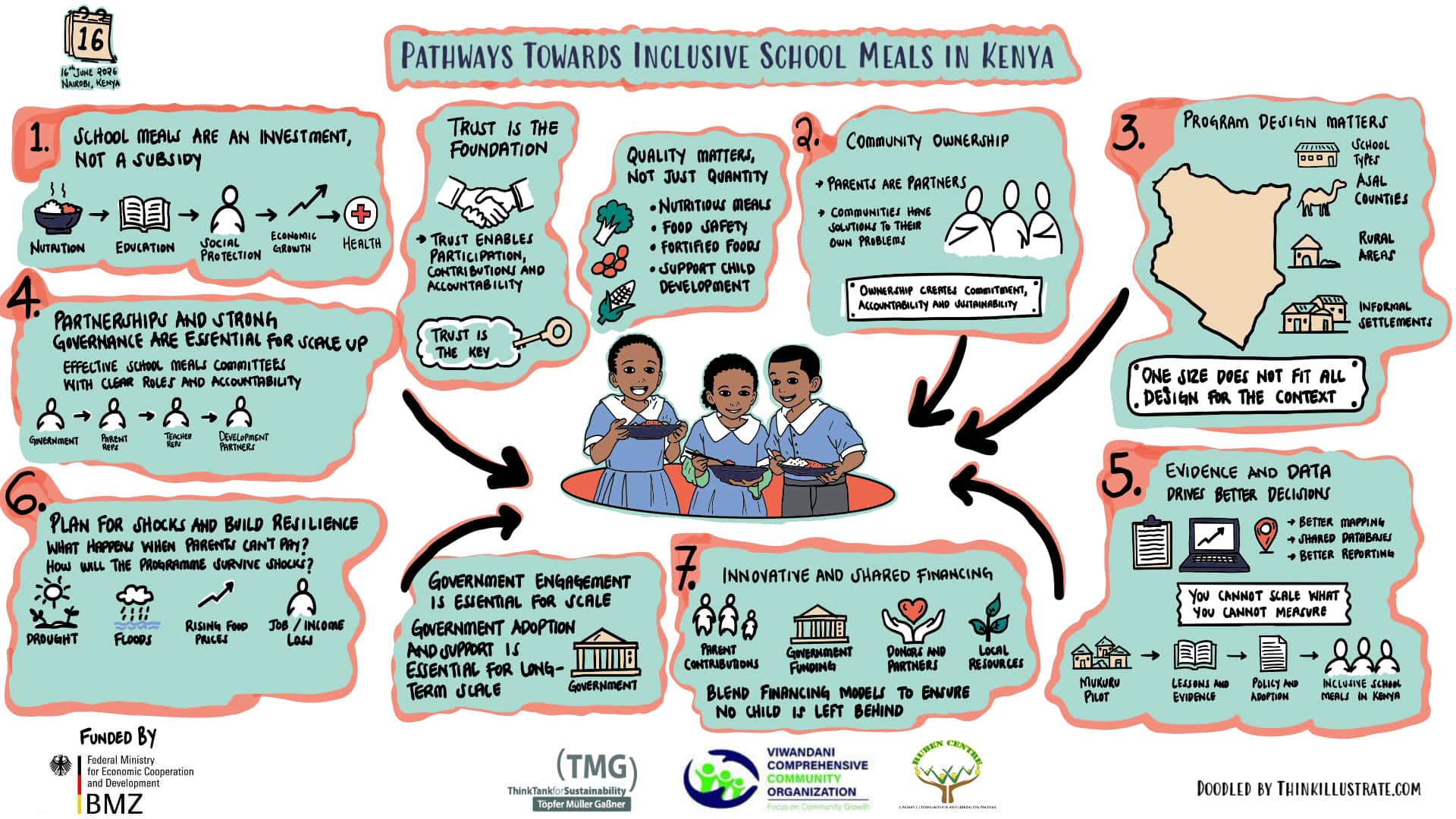
“School meals are not a subsidy; they are an investment in the future of our children and society.”
– Alexander Müller, Managing Director – TMG
Financing plays an important role, but it is not the only factor. Achieving universal coverage also requires deliberate attention to contextualised programme design, with reflection on the roles and responsibilities of the different actors involved. Effective programme design not only delivers operational and cost efficiency but also provides a strong basis for institutional sustainability, inclusivity by accounting for different needs, and equity through effective targeting mechanisms.
Leaving no one behind while reaching the furthest behind first remains one of the most important guiding principles of the 2030 Agenda for Sustainable Development. For school meal programmes, this principle must extend beyond rhetoric and be reflected in programme design and implementation. Its practical application can therefore be judged by a simple question: are programmes designed to reach those who are furthest first? This includes reaching children outside public school systems and in challenging contexts, such as informal settlements. Addressing this gap calls for honest and continuous dialogue among policymakers, implementing partners, researchers, civil society, and communities about where the blind spots are and how to address them.
Our engagements on school meals in Nairobi clearly demonstrate the power of both research and dialogue on these crucial topics. Research conducted by TMG, VICCO, and the Ruben Centre in Mukuru, one of Nairobi’s largest informal settlements, highlights disparities in access to school meal programmes among learners in informal settlements. More than 70% of primary school-going children in informal settlements attend non-formal complementary schools, which are outside the expansive county school meals programme. In the absence of formal provision, many schools and communities have sought to organise their own school meal programmes. However, these self-organised programmes have suffered from limited operational and institutional capacities by the schools and limited parent contributions.
In response to these constraints, TMG and its partners piloted an alternative model designed to strengthen programme delivery, local ownership and financial sustainability. The pilot programme reached six schools and served meals to over 1100 learners daily. Key milestones included reducing the cost of a meal from KES 50 to KES 25 and designing a cost recovery model that achieved an average cost-recovery rate of 85 per cent by the end of the second phase. From this, a number of key insights were generated on programme design, parent engagement, unlocking local financing, institutional design, and programme sustainability.
To share these findings and examine their wider relevance, TMG, in partnership with VICCO, and the Viwandani Community-led School Meals Programme Committee, convened a dialogue to present the key research findings to a broader group of stakeholders. The dialogue brought together policymakers, representatives from the Kenya Chapter of the School Meals Coalition, including the Technical Working Groups on Evidence Generation and Innovative Financing, as well as development partners and funders, implementing organisations, researchers and academia, and school, parent and community representatives.
The dialogue provided a platform to reflect on research insights and consider experiences from other school meal contexts, with the objective of generating shared learning and understanding on designing school meal programmes in challenging contexts. The dialogue also created a space for reflection on how the lessons from Mukuru can be adapted to different contexts, including other urban and informal settlements, rural, arid and semi-arid areas, as well as other relatively more stable contexts.
Several shared conclusions emerged from the dialogue:
First, equity must remain central to school meal expansion. Achieving universal coverage requires deliberate attention to children who are not reached by the current programmes and interventions, especially those in informal settlements, non-formal schools and other underserved contexts. While all children should benefit from school meal programmes, the true embodiment of leaving no child behind will be seen by deliberate efforts to start with the child who needs the meal the most and is also likely to be missed by the current programme design.
Second, programme design matters as much as financing. Participants emphasised that resources alone do not guarantee successful implementation. Even well-resourced programmes might miss their target if the design does not fit the context. Procurement arrangements, delivery systems, governance structures, accountability mechanisms and local adaptation are all critical to whether a school meal programme works in practice.
Third, strong community participation and ownership unlock local financing and parent involvement, which are key to sustainability. The Mukuru programme demonstrates that parent contributions can play an important role in the financial sustainability of school meal programmes. It also highlights the conditions under which this is possible. Parents are better able to contribute when meals are affordable and when they trust the programme implementation. At the same time, the discussions underlined that parent financing cannot replace public responsibility.
Fourth, school meals offer value beyond food. Participants reflected on their broader contributions to child well-being, community engagement, and social protection. The Mukuru example also clearly demonstrated the value of designing school meals programmes with additional value in mind. With the establishment of the VICCO Urban Nutrition Hub, the programme not only strengthened infrastructure for school meals but also provided the necessary space for nutrition training, a safe house for women and girls, and community building. This broader value, especially in underserved settings, should be considered and integrated into the design, financing, and evaluation of school meal programmes.
Beyond the discussions and reflections in the dialogue, participants unanimously agreed that greater engagement is needed to facilitate the sharing of lessons, challenges, and solutions to advance collective learning and progress towards sustainable school meal programmes. Initiatives of the school meals coalition, such as the countrywide mapping of school meals actors and their programmes, were lauded as key steps to consolidate insights into the different initiatives, their models, and reach. Building on these efforts will require shared knowledge and understanding of what different contexts need, what knowledge and experiences already exist, and how to capitalise on them.
The dialogue on designing school meal programmes for non-formal schools, convened by TMG and its partners, demonstrates how this type of structured learning and exchange can be put into practice. By bringing together stakeholders with different forms of experience and knowledge, the dialogue created a space to examine barriers to universal coverage alongside the policy, technical and financial resources available to address them. This way, lessons drawn from contexts such as Mukuru can inform current and future programme, inclusivity and equity discussions in both challenging and stable contexts.
- Land Governance Jun 24, 2026
Women don't live in silos. The Rio Convention's Gender Actions Plans should match this reality.
Frederike Klümper, Judith Rosendahl (GIZ), Venge Nyirongo (UN-Women), Dr. Birguy Lamizana (UNCCD), Jes Weigelt
- Land Governance Jun 17, 2026
Beyond Decisions, Laws, and Regulations: Why Are Pastoral Areas Still Shrinking and Farmer-Herder Conflicts Rising?
This World Day to Combat Desertification and Drought, we ask why pastoral land in Niger continues to shrink despite decades of legal protection, and what it will take for the commitments made under the UNCCD to actually hold.
Kader Baba
- Food Systems Apr 30, 2026
Building Back Better This Time? Responses to an Unfolding Food Price Crisis
Drawing two conclusions on our global food systems roughly two months after the closure of the Strait of Hormuz
Jes Weigelt, Violet Shivutse, Mino Ramaroson, Alexander Müller [1], TMG Research, Shibuye Community Health Workers, Huairou Commission

Written by Emmanuel Atamba, Cheboi Jerono