Women don't live in silos. The Rio Convention's Gender Actions Plans should match this reality.
by Frederike Klümper, Judith Rosendahl (GIZ), Venge Nyirongo (UN-Women), Dr. Birguy Lamizana (UNCCD), Jes Weigelt
Published on Jun 24, 2026
On 9 June 2026, two conversations on the same topic were taking place in Bonn, each adopting a distinct perspective. At the Bonn Climate Change Conference, negotiators debated whether the subsidiary bodies of the UN Framework Convention on Climate Change (UNFCCC) should do more to strengthen synergies among the three Rio Conventions on climate, biodiversity and land. Most parties supported the idea. Some resisted, citing risks of doing more than mandated. A delegate leaving the session told the Earth Negotiations Bulletin: "At the end of the day, we cannot just keep complaining about reporting burdens and duplication of efforts without providing a clear reform mandate." While the call for stronger coordination is growing, current progress is too little.
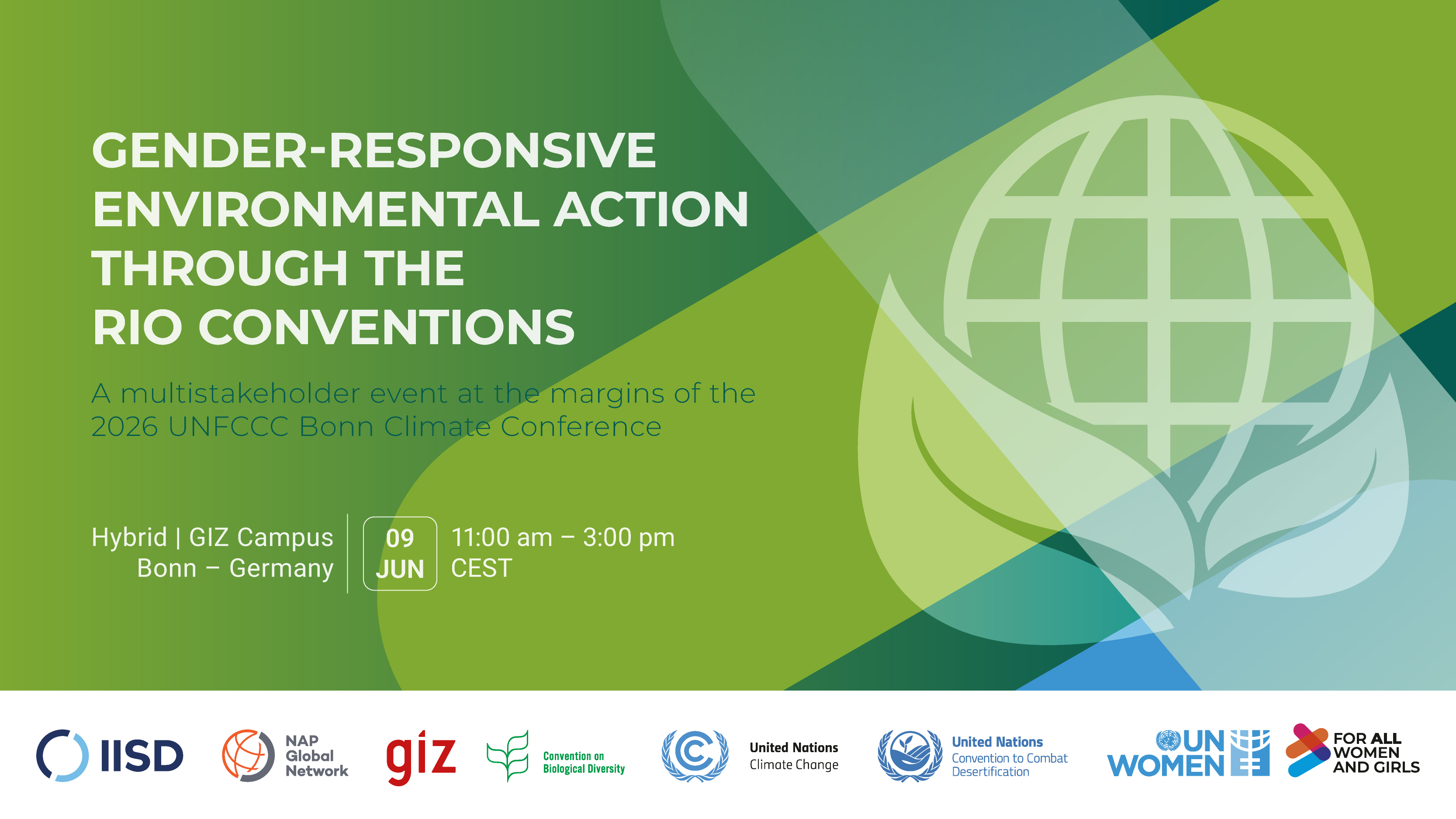
On the same day, a few streets away, GIZ, UN-Women and the Secretariats of the three Rio Conventions hosted a multistakeholder event on "Gender-responsive Environmental Action Through the Rio Conventions." National Gender and Climate Change Focal Points and National Adaptation Plan Focal Points were in the room, alongside civil society representatives and other stakeholders working at the intersections of the three conventions. Together they gathered to ask a different question: not how to adjust the global frameworks, but where the practical entry points for cross-convention synergies already exist.
The Gender Action Plans (GAPs) of all three Rio Conventions are one such entry point - a point also raised in UN-Women's 2024 Working Paper on Advancing Gender-responsive Synergies across the Rio Conventions. The GAPs point to something the formal negotiations have not yet fully recognised: each convention's GAP has developed distinct strengths that the others could learn from.
What three Gender Action Plans can learn from each other
The issue of gender equality is addressed differently in the three conventions, and the Gender Action Plans therefore differ as well. Further, the three GAPs have varying durations (CBD and UNCCD until 2030, UNFCCC until 2034) and different related ongoing processes (CBD midterm review of the GAP implementation culminates at this year's COP17, UNCCD starts its first informal discussion on the future GAP at this year's COP17). Against this background, rather than asking which framework all three should converge towards, a currently more productive question is what each can take from the others.
The UNCCD GAP is the most explicit on women's land rights. The most recent gender decision (UNCCD/COP(16)/22), adopted at COP16 in 2024, reaffirmed women's tenure rights as central to achieving land degradation neutrality (LDN). The UNCCD's own mid-term evaluation went further, describing women's economic empowerment and equal land use rights as "shortcuts toward LDN" and the most direct path to the convention's core objective. As Dr. Birguy Lamizana Diallo (UNCCD Secretariat) put it at the event, citing former UNCCD Executive Secretary Ibrahim Thiaw: "You cannot work in the morning saying today I am addressing climate change, tomorrow I will address biodiversity, and the day after I will talk about land. You have to tackle them at once."
The CBD, through its Kunming-Montreal Global Biodiversity Framework, has built the most advanced monitoring framework for gender-disaggregated land tenure of any of the three conventions, a model UNCCD and UNFCCC have not yet matched. UNFCCC's Belém GAP, adopted at COP30 in November 2025, offers something different again: the strongest architecture on gender-responsive finance, and the only dedicated priority area on cross-convention coherence, naming the Joint Liaison Group of the three secretariats as the coordination mechanism at global level.
Civil society is already acting on this complementarity. "The battle has not been lost," said Mwanahamisi Singano, representing the CBD Women's Caucus and UNFCCC Women and Gender Constituency at the event. "The mandate already exists in the CBD and UNCCD, and joint implementation of the (gender) action plans is where we can use it."
Who holds the key to Rio Convention gender-responsive synergies?
If learning across conventions is the goal, who makes it happen at national level? A study conducted by TMG Research, commissioned by GIZ WE4R, based on consultations in Kenya, Madagascar and Mali, gives a clear answer: national focal points (NFPs) are the natural bridge. Where gender focal points are also in place, they are the most direct connectors across conventions. Both have the mandate, know the national context, and are closest to where implementation happens. But in all three countries, the consultation workshops were the first time NFPs from the three conventions had been in the same room.
Behind that coordination gap is a chain that repeats itself across all three countries. Where there is no designated gender focal point for a convention, there tends to be no standalone national gender action plan. Where there is no plan, there is no dedicated budget. Where there is no budget, there is limited dedicated gender-responsive action.
And when action does happen, a further pattern emerges. It tends to address the easier wins first. The CBD's own mid-term review confirms this finding derived from an in-depth analysis of three countries alone. Of 110 parties that included gender targets in their national biodiversity strategies, 35 percent set targets on women's participation, but only 20 percent set targets on equal access to land and natural resources. In the language of BMZ's Feminist Development Policy and the 3R framework: Representation is moving forward. Rights and Resources remain the harder frontier.
Kenya shows what is possible when the conditions are in place. All three convention NFPs are based in the same ministry. One gender focal point now covers both CBD and UNCCD. A workshop the week before the Bonn event brought all three conventions together to discuss gender coordination and women's land rights further.
The window is open
Inequalities between women and men are still deeply ingrained in our societies. Addressing them is a key entry point to achieve the goals of the three Rio Conventions. The work on practical learning opportunities between the conventions needs to complement the negotiations between parties.
UNCCD COP17 in Ulaanbaatar in August is the first and most immediate moment. First discussions on lessons learned from the current GAP for the future one, alongside the UNCCD's Future Strategic Framework discussions, offer an opportunity to anchor gender-responsive land management and women's land rights firmly in UNCCD's next decade, and to draw on what the CBD's monitoring framework has already shown is achievable. CBD COP17 in Yerevan that October will take a decision on how to strengthen GAP implementation based on the mid-term review, a fortuitous moment for deepening coherence with the other two processes. UNFCCC transparency reports, due in December 2026, are an additional opportunity across all three conventions.
The discussion does not end in Bonn. TMG Research, GIZ, UN-Women and the Rio Conventions' Secretariats are all members of the Women's Land Rights Initiative (WLRI), a growing coalition working to advance women's land rights across the Conventions. The WLRI will take the conversation forward at its next convening in Nairobi at the end of June 2026, with a specific focus on what cross-convention coordination on gender and land rights can look like in practice at country level.
The Women's Land Rights Initiative: placing land rights at the heart of just climate action
Our latest video showcases why women’s land rights must rest at the heart of just climate action.
Dec 02, 2024
Info Brief
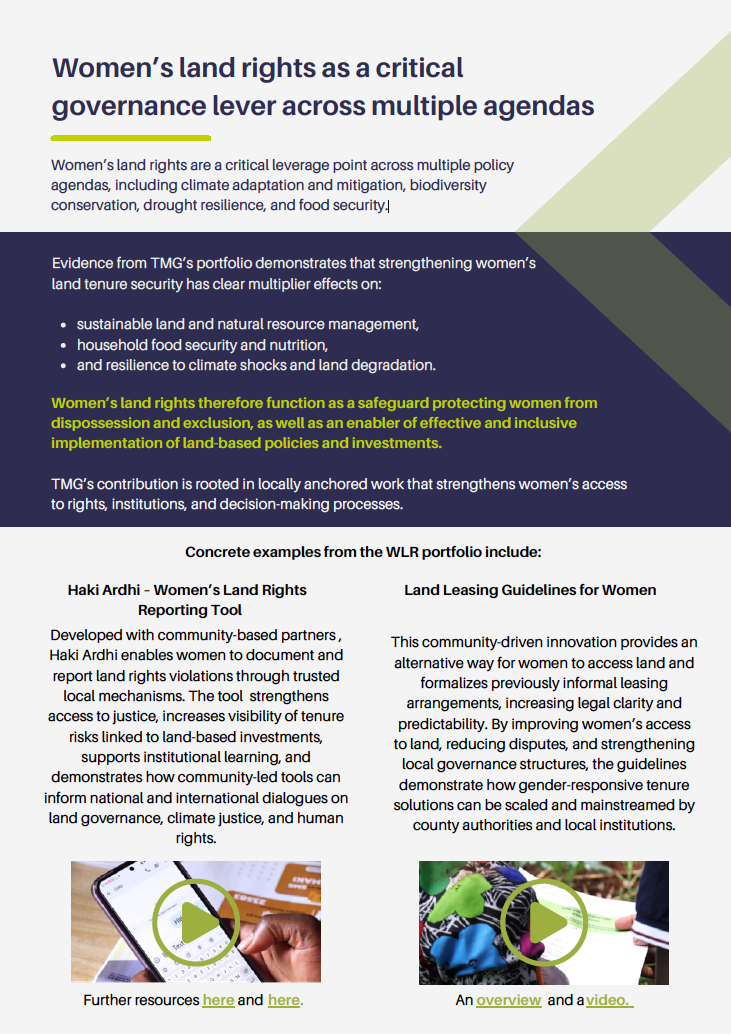
Women's Land Rights as a Critical Governance Lever Across Multiple Agendas
Women’s land rights are a critical leverage point across multiple policy agendas, including climate adaptation and mitigation, biodiversity conservation, drought resilience, and food security.
Written by Frederike Klümper, Ilse Pelkmans
Published on Feb 20, 2026
Brochure
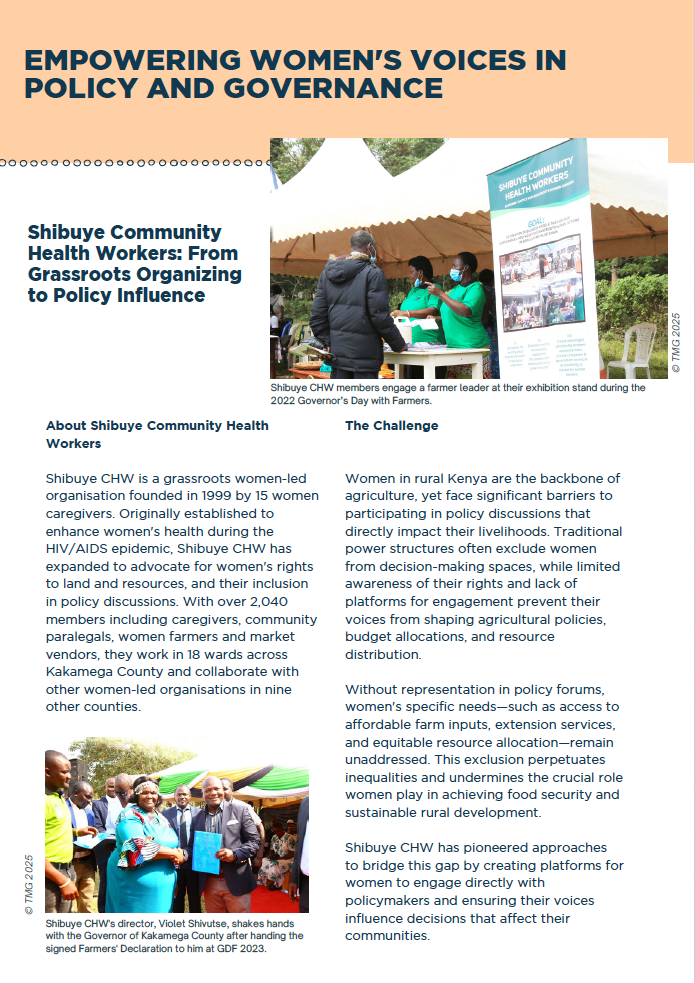
Empowering Women's Voices in Policy and Governance: Shibuye Community Health Workers, From Grassroots Organizing to Policy Influence
Women are central to Kenya’s agricultural systems, yet remain largely excluded from decision-making. In Kakamega County, Shibuye Community Health Workers is creating pathways for women’s voices to shape county policies, budgets, and governance outcomes.
Written by Axelina Gunnarsson
Published on Feb 04, 2026
Info Brief
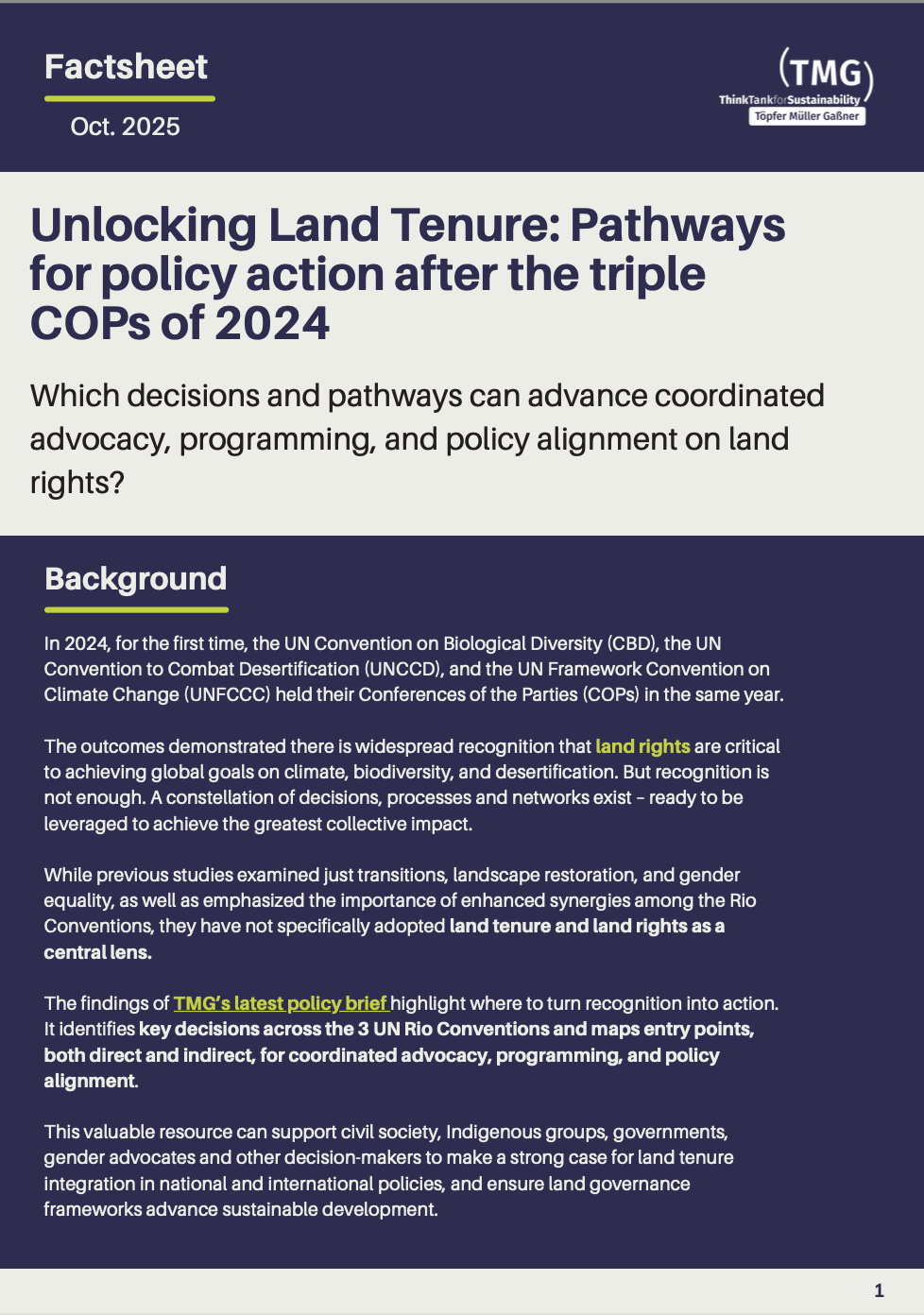
Factsheet: Unlocking Land Tenure: Pathways for policy action after the triple COPs of 2024
2024 – the year of the triple COPs – showed growing recognition that land rights are critical to climate, biodiversity, and desertification goals. This factsheet highlights where to turn recognition into action.
Written by Frederike Klümper
Published on Oct 21, 2025
Report
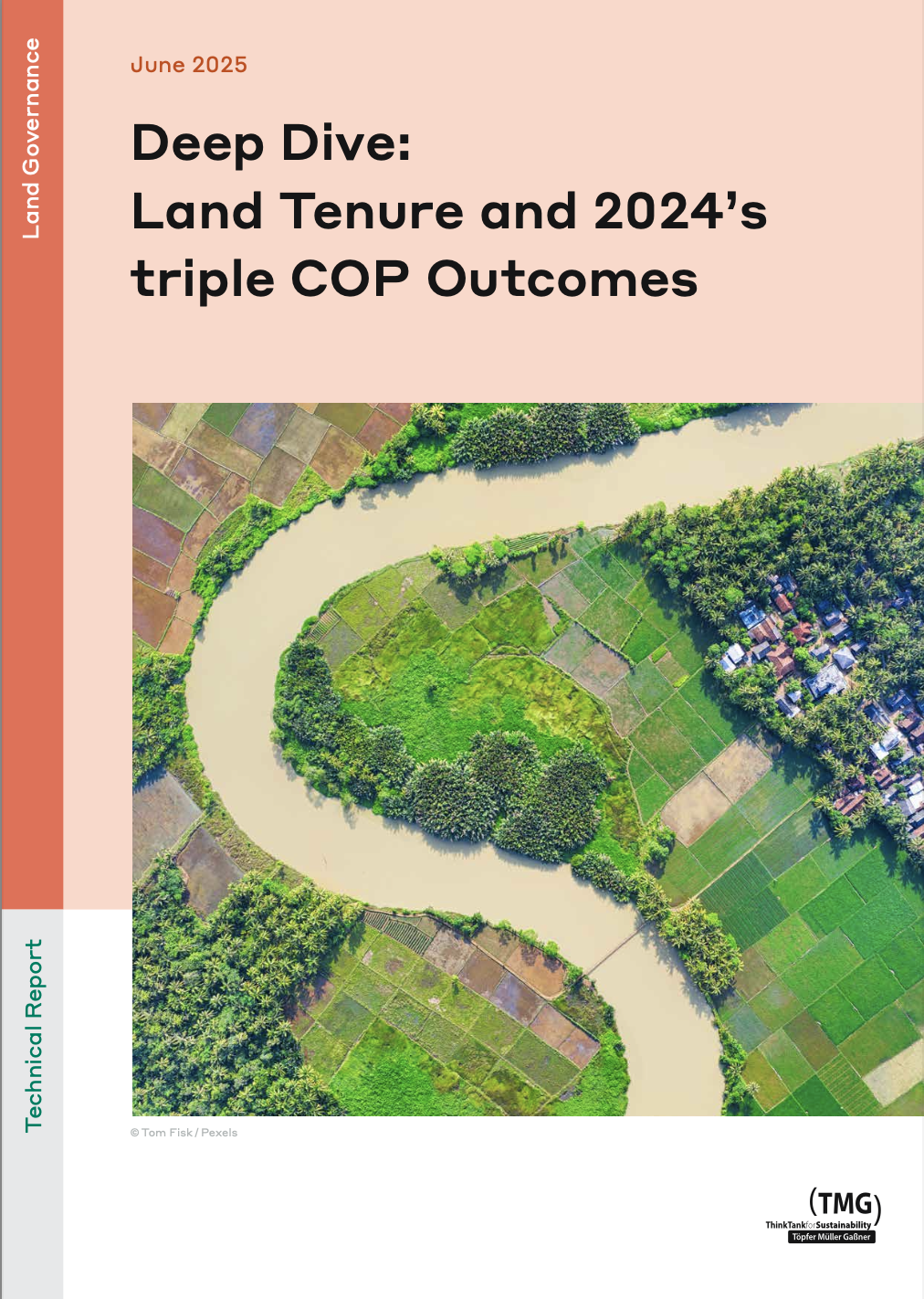
Deep Dive: Land tenure and 2024's triple COP outcomes
This technical report offers deep insight into land tenure-related outcomes from 2024's year of triple COPs across the three Rio Conventions. It identifies synergies and actionable entry points to strength the protection and recognition of land rights.
Written by TMG Research
Published on Jun 06, 2025
- Urban Food Futures Jul 27, 2026
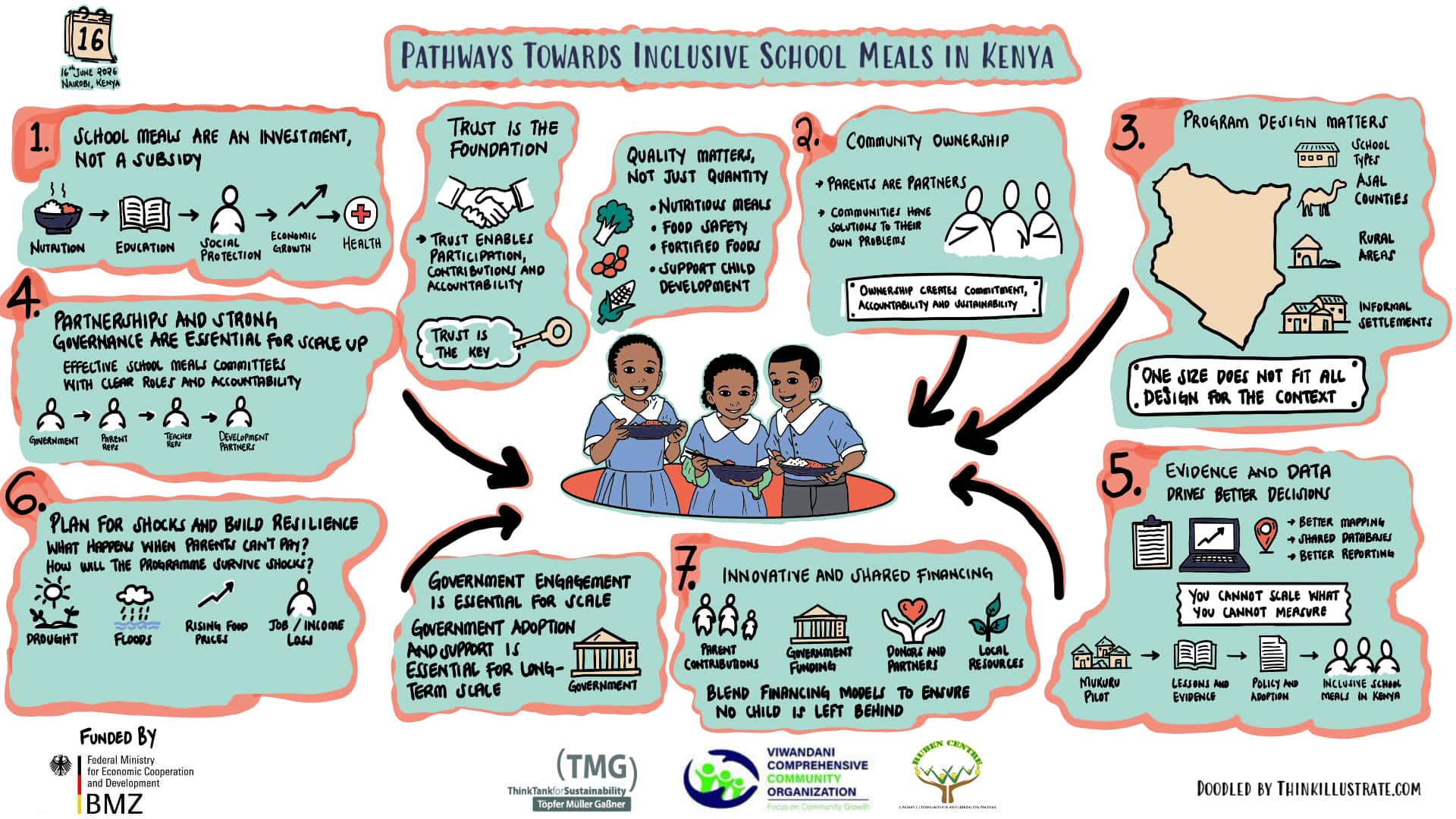
Advancing Inclusive and Sustainable School Meal Programmes
TMG Research and its partners convened a stakeholder dialogue to launch a policy brief and facilitate dialogue on the design, financing and sustainability of inclusive school meal programmes, drawing on lessons from Mukuru.
Emmanuel Atamba, Cheboi Jerono
- Land Governance Jun 17, 2026
Beyond Decisions, Laws, and Regulations: Why Are Pastoral Areas Still Shrinking and Farmer-Herder Conflicts Rising?
This World Day to Combat Desertification and Drought, we ask why pastoral land in Niger continues to shrink despite decades of legal protection, and what it will take for the commitments made under the UNCCD to actually hold.
Kader Baba
- Food Systems Apr 30, 2026
Building Back Better This Time? Responses to an Unfolding Food Price Crisis
Drawing two conclusions on our global food systems roughly two months after the closure of the Strait of Hormuz
Jes Weigelt, Violet Shivutse, Mino Ramaroson, Alexander Müller [1], TMG Research, Shibuye Community Health Workers, Huairou Commission
Written by Frederike Klümper, Judith Rosendahl (GIZ), Venge Nyirongo (UN-Women), Dr. Birguy Lamizana (UNCCD), Jes Weigelt